Nathan's Notebook
|
|
|
---by
Nathan Bierma
Column:
Blogs:
Book: Friends:
Strands:
|
NBierma.com > Notebook
from Twitter
| Follow me!
Wednesday, December 01, 2004
This week in my B&C blog: November news and book review roundup. LINK/ARCHIVE My latest B&C Corner: A report from the National Communication Association convention here in Chicago. http://www.christianitytoday.com/books/features/weblog/041129.html My latest Tribune language column has been postponed to accommodate an illustration; it's actually a longer feature on the controversial history of the name "Windy City." It should run either Friday or next Tuesday; stay tuned.
[The blog was looking a little blah, so I put up this pic as a way to say Happy December! more pics/animation] Meanwhile, here's a brief I submitted, that didn't run, on haymaker: Several reports of last week's Pacers-Pistons brawl made the participating pugilists sound like farmers, describing the punches exchanged by players and fans as "haymakers." Over half the results for "haymaker" on a Lexis-Nexis search of the past week refer either to the melee in Detroit or the South Carolina-Clemson football brawl the next day. [Sources note that the Random House Historical Dictionary of American Slang has "haymaker" in the sense of "a hard swinging blow" dated back to 1902.] From the OED: 1. A man or woman employed in making hay; esp. one engaged in Inflections • Tis the season: DTTW on door buster n. a discounted item of limited quantity intended to bring customers into a store; a sale of such items; a loss-leader. Also attrib. Categories: Also see ESPN The Magazine on the roots of "boxing ring." • LL on venti and other verbal concoctions of Starbucks: [T]he Starbucksian marketeer who came up with the name was probably thinking of the Italian for "twenty". Or "winds", take your pick. Of course, the Italians would use the metric system, and 20 fluid ounces in metric is approximately 591.476 cc, but I don't think that cinque nove uno virgola quattro sette sei is going to make it as a product name. I guess you could round up and call it seicento. • Ever notice how better can be ambiguous? I asked my wife how she was feeling, and she said, "I'm better." "All better?" I asked? No, but better, she had to explain. It made me realize better is idiomatic here; it really should be "best." After all, you wouldn't say "all stronger." Update: It gets even crazier. An ad says, "With Nexium, you don't just feel better, you are better. And better is better." • My sister gave me this notepad for my birthday a couple months ago, just took a picture of it with my new phonecam:
• I also asked my sister, a college student in Ontario, about this excerpt of native Canadian by Geoff Pullum: "Cripes! Grade thirteen! Here's a loonie -- buy yourself a Coffee Crisp, eh?" Lisa says: "That was entertaining. I would like to point out that I have never ever heard the expression "Cripes" in Ontario (or anywhere else). Also, grade thirteen and OAC's are not equivalent to SAT's. SAT's are tests, OAC's are classes. They are more like AP courses." • This adjective and noun phrase in the opening of this Slate's review isn't sitting right with me: "National Treasure, another Nic Cage-starring movie from blow-'em-up producer Jerry Bruckheimer..." That may make sense--I'm not sure--but I think it's too awkward to be worth it. But I like "blow-'em-up producer." It's as good as the first phrase is bad. • More from DTWW: yard sale n. in skiing or other snow-based sports, a fall or spill; a wipeout. [Perhaps from the appearance of "sporting goods spread out all over the yard."] Categories: English. Slang. Sports. x leitkultur n. mainstream or guiding culture. [German leit 'leading (adj.); leader' + kultur 'culture'] Categories: Germany. German. x • I was moved to look up the etymologies of berserk (or beserk, as I thought it was spelled) and hubbub (or hubub, as I thought it was spelled) berserk • Etymologies can be deceiving. For example, when I read that feign came from the Latin "fingere," the verb for "shape" (since "feign" means to "fashion an impression or shape an image," as M-W says; figure, effigy, fiction, and figment are cognates), I assumed that this is where finger comes from, too, since we use fingers to give things shape. But it's just a coincidence. From OnEtDc: finger: • I also wondered if ever was a cognate of aver and very. Nope. At least not at the level of Latin; maybe P.I.E. OnEtDc again: ever • From Michael Wittmer's new book on heaven and worldview (hey, that was my idea!) Metaphysics ... entered our vocabulary by a fluke of history. The great philosopher Aristotle once gave a series of lectures on the nature of reality. Since these lectures on reality appeared on the shelf after his lectures on physics, one of his students began calling this branch of philosophy "metaphysics," meta being the Greek word for "after." Thus the term "metaphysics" simply means the study of reality. • Previous column and inflections • Etymology Today from M-W: arduous\AHR-juh-wus\ 1 a : hard to accomplish or achieve : difficult *b: marked by great labor or effort : strenuous 2 : hard to climb : steep "To forgive is the most arduous pitch human nature can arrive at." When Richard Steele published that line in The Guardian in 1709, he was using "arduous" in what was apparently a fairly new way for English writers in his day: to imply that something was steep or lofty as well as difficult. Steele's use is one of the earliest documented in English for that meaning, but he didn't commit it to paper until almost 200 years after the first uses of the word in its "hard to accomplish" sense. Although the "difficult" sense is older, the "steep" sense is very true to the word's origins; "arduous" derives from the Latin "arduus," which means "high" or "steep." • Previous E.T. And I thought life's big questions were supposed to be hard; all you have to do is click here for "33 Amazing Laws of Success and Prosperity" ... ... or bone up on your Encyclopedia Britannica, like this guy did. New Social Security Plan Allows Workers To Put Portion Of Earnings On Favorite Team x Office-Newsletter Editor Refuses To Back Down x Childhood Friend Stops Writing After Two E-mails x Friday, November 26, 2004
My B&C blog is idle this week. My latest Tribune language column: On the word "co-family" as a replacement for "stepfamily." temp link/perm.preview I thought about starting the article with this Paul Reiser joke, but it didn't work out: Comedian Paul Reiser once joked that there's a greeting card for every possible situation: "From the Three of Us to the Three of You," "From Some of Us to All of You," "From Both of Us to Nobody in Your Area." More from Wayne Glowka on euphemisms: "Undertaker" sounded better than "gravedigger"; perhaps "funeral director" sounds better than "undertaker." "Grief specialist" sounds specious and Re: gypsy: Dictionary.com lists the American Heritage Dictionary's entry for "gypsy" as its primary definition, identifying gypsies as descendants of migrants from northern India who "have preserved elements of their traditional culture, including an itinerant existence and the Romany language." AHD's fourth entry for "gypsy" is "one inclined to a nomadic, unconventional way of life. A person who moves from place to place as required for employment." Inflections • ASD-L says the season's greetings of an ad for Virgin Mobil talks about Chrismahanukwanzakah • An advisory at woodtv.com for Wednesday's storm predicted that "snow will continue to overspread southern lower Michigan this afternoon." • Ad for some truck: "Roomier. Brawnier. Versatilier." • One of Letterman's Top Ten Signs You're Watching A Bad Disaster Movie was ""Explosions" are just crew members shouting, "Pcchewwwww!"" Here's where I wish I knew the IPA, but that spelling doesn't sound much like the usual explosion noises I've made and hear people make. There's a K and an F in there, and some kind of an SH. I was going to try to spell it, but I can't. • Is this the origin of queen meaning queer? Apparently nasty rumors surrounded King James (of the King James Bible). From Wikipedia: "When James inherited the English Throne in 1603, it was openly joked in London that Rex fuit Elizabeth: nunc est regina Jacobus (Elizabeth was King: now James is Queen)." • The LRB looks up naughty URLs. • LL on the excess politeness of writing "X was killed when the SUV he was driving hit a tree." (Don't you just hate it when the SUV you're driving hits a tree?) • Language and the Onion: QUINTER, KS—Sophia Reed, 7, dominated Monday's Family Game Night, thanks in part to her inscrutable Uno face, family members reported. "She'd just sit as quiet as a church mouse, then hit me with a 'draw four wild card,'" said Leo Reed, Sophia's grandfather and Uno opponent. • The Online Etymology Dictionary's plea for sponsors for certain pages is clever: "Sponsor 'peace'. Give your boyfriend 'lust.' Show your appreciation for 'candy.'" • If the English subjunctive was dying, the Toronto Sun may have just yanked at its plug, says RC.
Speaking of which, I want to diagram the name of the song from Moulin Rouge that my wife and I danced to at our wedding: "Come What May." I can't figure out if "may" is a subjunctive; is it an auxiliary in a subjunctive construction? I hate my grammatical ignorance. • ""everynow and then" gets about eight thousand hits" at Google, says ASD-L. • From FT: In their extended commentary the editors contend, and the collection demonstrates, that notoriously fissiparous evangelical enthusiasms are, in recent decades, converging in a creedal affirmation of the Great Tradition grounded in Scripture as authoritatively interpreted by the early fathers and councils of the Church. M-W: fissiparous Etymology: Latin fissus, past participle of findere + English -parous : tending to break up into parts : DIVISIVE • "Oh well, right?" my wife said/asked me this morning. I thought that was interesting: using the interjection "oh well" to make the statement "it is not important," then asking me to confirm the statement. Or was she quoting it--"'Oh well,' right?"--as in, "'No pain, no gain,' right?" more • QT on viz: QT Grammar R Us Seminar on the English Language (cont'd): • DTWW says says there's such a political slang term as if-by-whiskey speech: "southern US regionalism: a speech coming down emphatically on both sides on an issue." From the days when any good southern politician had a speech of this sort at the ready, concerning his views on spiritus ferminti. Several such passages are of record, of which this is the best. Supposedly from a Mississippi legislator in 1958. • Previous column and inflections • Etymology Today from M-W: purlieu\PERL-yoo\ 1 : an outlying or adjacent district 2 plural : environs, neighborhood 3 : a frequently visited place : haunt 4 plural : confines, bounds In medieval England if you were fortunate enough to acquire a new piece of land, you might hold a ceremony called a "perambulation," in which you would walk around and record the boundaries of your property in the presence of witnesses. If your land bordered a royal forest, there might be some confusion about where your land started and the royal forest ended. Luckily, the law said that if you performed a perambulation, you could gain at least some degree of ownership over disputed forest tracts, although your use of them would be restricted by forest laws and royals would probably still have the right to hunt on them. Such regained forest property was called a "purlewe" (or as it was later spelled, "purlieu"), which derives from the Anglo-French word for "perambulation." • Previous E.T. More from the Sun-Times' QT column: News Headline: "13-year-old boy charged with abducting exotic dancer." From a column I clipped by Michael Kelly, on why saying something well doesn't make it true: All happy families resemble one another, but each unhappy family is unhappy in its own way? No, that is exactly wrong. Happy families are wildly, even eccentrically, diverse. But in every unhappy family, as any social worker can tell you, you will likely find the same dreary woes: dead love, physical or psychological brutality, alcoholism, infidelity, poverty. Newsweek's Jonathan Alter on Terrell Owens, Desperate Housewives, and hypocrisy: First, the good news. If this had happened 20 years ago (and it could have; TV was full of sexual innuendo then, too), all the talk would have been about the interracial coupling of Sheridan and Owens. This time, the hottest of hot buttons in American history-the source of countless lynchings-caused barely a public peep. White House Thanksgiving Turkey Detained Without Counsel x FDA Okays Every Drug Pending Approval, Takes Rest Of Year Off x Pabst Still Coasting On 1893 Blue Ribbon Win Wednesday, November 24, 2004
Happy Thanksgiving! From my Thanksgiving post two years ago: • The menu for the first Thanksgiving dinner included fish, venison, corn, squash, berries, and corn bread. There's no record that turkey was on the table. • Benjamin Franklin, advocating the turkey as the national bird: "The Turkey is in comparison a much ore respectable Bird, and withal a true original Native of America.... He is besides, though a little vain & silly, a Bird of Courage, and would not hesitate to attack a Grenadier of the British Guards who should presume to invade his Farm Yard with a red Coat on." More: • In this morning's Sun-Times, QT spoils your Thanksgiving dinner: Relish trays contain aflatoxins, benzaldehyde, quercetin glycosides and hydrogen peroxide. QT also notes that as travelers clog airports today, security personnel are reportedly getting less modest when it comes to "patting down" passengers. "And remember," QT says, "even as you are being patted down, that, even at that moment, the Transportation Security Administration is allowing uninspected cargo onto your airplane." Seriously, safe travels, all. Update: from AHD at hmco.com: turkey Thursday, November 18, 2004
This week in my B&C blog: On the decline of expository preaching, as politics and psychology dominate the pulpit. Also: Why Manhattan is good for the environment, the true story behind premium gas and fortune cookies, and more ... LINK/ARCHIVE Skip to my language column My latest B&C Book of the Week:
Review of Autumn: A Spiritual Biography of the Season. http://www.christianitytoday.com/books/features/bookwk/041115.html I wanted to use the phrase "fiery folial finery," but I thought that would just be a pile of glop. More on autumn leaves here and here. Another brilliant picture here. My latest Det. Free Press op-ed: Why I'm a "values voter" and went for Kerry. http://www.freep.com/voices/columnists/ebierm16_20041116.htm • I got the 8 in 10 stat here, but Christianity Today has a much better breakdown of the "values voters" numbers here. (Also see Slate on why James Dobson must choose either church or state.) • At the risk of making it look like I'm tooting my own horn (my wife will tell you I do enough of that after we eat at Chipotle), I wanted to pass along some of the e-mail responses I got as a way of exhorting fellow left-leaning Christians to keep the faith. I was stunned that of the over 40 e-mails I received, all but a half-dozen were positive (My favorite negative one was this: "I guess at our local paper in metro Detroit, we ran out of liberals to write columns so we are starting to recruit them from neighboring communities.") Here are a few fellow bleeding hearts: - I would like to tell you how heartening it is to know that there are Christians out there who think the same way as my family. After the elections, I did not want to go back to our church and be associated with people who limited their Christianity to 2 issues. It seems the whole country is full of them. I know God is sovereign and in control but I am struggling with the fact that an incompetent person is once again at the helm. ... Let's not stop praying for our country. • Some of the negative responses I received said there was a contradiction between my points that values always affect voting but that church and state should be kept separate. I should have clarified that. The difference is this: the institutions of the church and the government should be kept apart (so James Dobson should not seek to be a power-broker in the Republican Party, as he is, and President Bush shouldn't be a figurehead for certain religious groups, as he seems to be). The church must speak truth to power without becoming part of that power. But individual citizens couldn't separate their values (whatever they are) from their voting if they tried. • I was a little reluctant to publish this op-ed, since some consider it bad form for a journalist to disclose her voting preference (others appreciate it; but since a sizeable majority of those in mainstream media vote Democratic, there isn't much suspense to begin with). If I were a news reporter instead of a features writer, I might not have done it. My reluctance came from the likelihood that some readers will now dismiss everything I write about anything, since they have successfuly identified me as a member of a vast left-wing conspiracy, an evil empire whose corruption of my cerebral capabilities is so complete that I am unable to put together a single sentence without submitting to it and extending its nefarious influence. Meanwhile, those who agree with me may presume that I bat for their team and have abandoned any effort to locate wisdom among people with different views. They, too, are wrong. If you think that either of the above is true, I despair of persuading you that my articles about language and other topics should be read in their own context and on their own merits, rather than as undercover dissemination of an agenda that will either degrade or transfigure America. So I leave it up to you. My latest Tribune language column: On the fascinating history of the alphabet. temp link/perm.preview This was cut: As a result, C has multiple personalities, changing sounds in the words “critic,” “dance,” “ocean,” “chain,” and “indict”). The letters M, B, and D are the easiest to say, so they're the first sounds out of the mouths of babies ("ma," "ba," and "da"). The sounds "er" and "sh" take them longer to learn. Also see this chart on various world alphabets. From the Plain English Campaign, 10/7 Last week we set you the puzzle of trying to work out the abbreviations in the following passage. Inflections • The Daily Show's Ed Helms described the Democracts as "feckless--devoid of feck." M-W: Scots, from feck effect, majority, from Middle English (Sc) fek, alteration of Middle English effect • Another Comedy Central show, which is animated, is called "Drawn Together." • A reader asked me about the word triennial. I had to look it up: M-W: 1 : occurring or being done every three years (the triennial convention) 2 : consisting of or lasting for three years (a triennial contract) AHD: ADJECTIVE: 1. Occurring every third year. 2. Lasting three years. NOUN: 1. A third anniversary. 2. A ceremony or celebration occurring every three years. So I advised that treat it like biannual/biennial: biannual - twice a year biennial - once every two years triannual - three times a year triennial - once every three years • A CTA infomercial on Windy City TV (trust me, it was better than anything else in prime time last Wednesday after West Wing) referred to bus drivers as bus operators. Who in the world--outside of CTA headquarters--actually calls them "bus operators"? • From wordcrafter: Vixen is one of extraordinarily few words beginning with v which comes from Old English, rather than a foreign tongue, typically French or Latin. (The only others are vane and vat.) • Two interesting words posted recently at DTWW (I especially love the second one): king v. among graffiti artists, to (pervasively) paint one’s name or symbol (throughout an area); to own an area through tagging or bombing. link [Is this like checkers? "King me!"] unass v. to dismount or disembark (a vehicle); to get off of (something); to unseat (someone); to leave (somewhere). link • Nicholas Kristof quoted the following in a recent column: "When a Texas governor, Miriam "Ma" Ferguson, barred the teaching of foreign languages about 80 years ago, saying, 'If English was good enough for Jesus Christ, it's good enough for us.'" ASD-L says there's no evidence for this quote, though there is for a related quote from a different person. more (at bottom of page) • Previous column and inflections New Yorker moview review links I want to save: Anthony Lane on Wicker Park, Motorcycle Diaries, P.S., Enduring Love, and The Incredibles; David Denby on I Heart Huckabees, Vera Drake, Sideways, and Ray. 10 so-called bright ideas from the London Guardian: 1. The Environmental IQ: profiling the impact of products 2. Hibernation Day: an international duvet day for the world 3. Fame Lottery: people get their 15 minutes, money goes to charity 4. A city/country house swap network to house everyone efficiently 5. Lottery entry slips to have a tick box for 10% to charity 6. A proportion of defence spending to tackle the causes of terrorism 7. Heavy parking fines (but only for persistent transgressors) 8. Charging the candidates for political apathy 9. A focused eco-tax on using animals in product marketing 10. Using cartoons to assess middle management problems more ... Also from the Guardian: superstitions of the British isles I hope lightning from heaven strikes whoever actually wrote about God's comeback in a headline about election and religion: Religion plays new election role God's comeback changes interplay between hopefuls Three years. I started this blog on November 14, 2001, as an intern at the Chicago Journal. So many links, so much ... junk, really, though I've tried to keep things substantive here. Of course, I've since started a blog at booksandculture.com, and so it's rather unseemly to ask people to read two blogs now. For that reason--and for the principle of it--I'm determined to do less blogging and more reading in the next 3 years. It won't be easy. Addictions die gradually. The post to end all posts Here lie links I don't want to lose but don't want to clog my bookmarks folder, either. They go to show that for all the compulsive instaneity of blogs, sometimes the most worthwhile links are to longer and older pieces of writing. Skip this • 2Blowhards on bestseller lists, Mozart's economics, and Frank Lloyd Wright • Alfred Bierstadt paintings • Archaelogy interview with Robin Lane Fox, classics scholar and advisor to the film Alexander. • Atlantic Monthly on truth and articulation, the computer delusion, Annie Dillard on appalling fecundity, the Market as God, the moral state of marriage, the state of America in 1987, Guglielmo Ferrero in 1913 on the riddle of America, and David Brooks on democratic elitism • The Australian on Shakespeare • Banner of Truth archive; pedestrian lives and glorious destiny • The BBC on a ride in the clouds of Eritrea • Beliefnet on Science and Religion: The New Convergence; Gregg Easterbrook on secular humanism; Alan Wolfe on Rick Santorum. • Blogistan Theology blog • Books&Culture: C. Stephen Evans on Kierkegaard, jottings on back of movie poster • Book Magazine on the lives of fiction writers • Boston Globe on the no-kids movement • Brain, Child on what motherhood does to you • Brad DeLong review of Guns, Germs and Steel • Brookings Review on Russia's geography and economics and trends in math • BrothersJudd.com review of Nickel and Dimed • Butterflies&Wheels on postmodernism and truth • ByFaithOnline Paul in Athens; Do Not Be Conformed • California State's Michael Foucault pages • Calhoun Community College on Southern Literature and Culture • Calvin College exhibit: Religious Observation within American Protestant Homes; Lewis Smedes obit and links • Calvin Institute of Christian Worship on justice in worship and Neal Plantinga on Isaiah 60 • Calvin Theological Journal: John Bolt on common grace and civic good • CBS News on online searches for classmates http://www.cbsnews.com/stories/2003/05/05/60II/main552363.shtml • Center of Theological Inquiry on Einstein and God (more here and here); Stanley Hauerwas on Bonhoeffer; Moltmann on Western values; N.T. Wright on Paul and Caesar • Chicago Reader's Straight Dope column on butlers in whodunits, deja vu, the hiccups, the right to bear arms and more • Chicago Tribune on Dave Eggers, Julia Keller's Pulitzer • Chimes on Grand Rapids sports • Christian History on the Reformation and the sola scriptura principle, Calvin and missions • Christianism bibliography; NT history • Christianity Today on the definition of an evangelical, tradition vs Scripture, why not to imitate Christ, Robert Bellah and the sociology of religion, why God loves baseball, Philip Yancey on the need for gracious evangelicalism and holy sex • Christian Science Monitor on how a bullet started a friendship in South Africa • Christian Thinktank on the soul; women in Paul's epistles • Chronicle of Higher Education on the economics of government help for the poor, the study of emotions, Shakespeare and pop culture, Is grad school a cult? • Comment on the next neo-Calvinism; our civic ties; CCO Jubilee on Kupyer • C.S. Lewis links index and book synopses; quotes from The Weight of Glory. More apologetics links • Dead Poets Society script • Debra Rienstra's Great With Child reviews • Democracy in America text • Detroit News on malls and 'lifestyle centers', Billy Sunday, more Detroit history • DoHistory's Martha Ballard's diary • The Economist on the homosexuality in the 19th century (more), review of The Earth: An Intimate History on eBay • Elliott Bay Booknotes on books on deserts, on indep bookstores (more) • ESPN.com on athletes and video games • FAA.gov on bird strikes and migration patterns • First Things on the history of moral philosophy, Jane Austen and theology • Flak on sports franchises and economic development • Forbes on neuroscience and marketing • Founders.org on evangelism and Calvinism • Gadfly on a day in the life of a Parisian cafe • Geoff Nunberg's timeline of the history of information • G.K. Chesterton quotes • Good Will Hunting script draft • Globalization bibliography • GreenwichMeanTime.com on the uses of GMT • The Guardian Beethoven's lover, Google tricks, on Chekhov, reviews of Space Between Our Ears, Our Shadowed Present, Living With a Writer, Making Stories: Law, Literature, Life, Myths We Live By, Unbearable Lightness of Being • Haddon Robinson sermons • Hans Christian Andersen's The Emperor's New Suit (1837) • Hornes.org on a Calvinist Christmas • HUD on West Michigan regional activity • Hudson Review on Ovid • Human Nature Review on evolutionary psychology • Isaiah Berlin's Two Concepts of Liberty • James Lileks on political lumping and a day in his life • John Ellis blog • James Wood on John Updike, on beauty, on J.M. Coetzee • Jonathan Harwell links • Kalamazoo's historic buildings • Lawrence Crowl on the naming of the months (more here, here, here, here, here, and here) • LinksNorth.com on the history of Canada • Linguistix on the relationship between knowledge and understanding • The London Review of Books on Pattern Recognition, conjoined twins, the history of touch and power, the politics of sin in American history, Left Behind, and Terry Eagleton on The Representation of Reality in Western Literature • Mad About You finale script • Martin Marty on Christianity and Literature and Irony and Religion • MaryLaine.com's neat new Net stuff • Matrix review essays here, here and here • Melbourne Age on sex in the suburbs • Michigan History back issues • Monty Python scripts • NPR's Fresh Air interviews with Simpsons writers and actors • The New Criterion on Hugh Kenner (more) and the role of the critic • The New Dictionary of Cultural Literacy (contents) • The New Republic: Richard Posner on Sherlock Holmes • New York magazine Michael Wolff archive; David Denby on Wag the Dog • New York Observer Jason Gay archive • New York Review of Books on gays and genes, Mark Twain, history of masturbation, review of Nature via Nurture • New York Times on its font change; series: six months in the life of a NYC classroom; how non-profits are benefiting from post-bust dot-com real estate vacancies; air passengers carrying on meals; strangers carpooling; cellphone towers in church steeples; writing students expecting hollywood offers; anniversary of NASDAQ peak; faith vs. reason; virtual museums; more on museums; the metaphors of football; A.O. Scott on the history of sex research; Peter Steinfels on Walter Rauschenbusch and the social gospel; review of Einstein's Clocks, Poincare's Maps; review of James Wood's Book Against God • New Yorker on traffic; the history of childhood; Tocqueville (more); Stanley and Livingstone; James Wood on God's Secretaries; scandals at the NY Times and CBS News (more); Roger Angell on the Red Sox' championship; Richard Wilbur's poetry; writer's block; Desperate Housewives; Nicholas Lemann on hatred of the media • Nietzsche's second "Untimely Meditation," review • Ohio U on agenda-setting and the media • Oregon State's Daniel Taylor on Roman coins • Oxford American back issues • Religion-online.org link • Philosophy Now on Charlie Brown as an existentialist • Plus on why cars in the next lane go faster • Policy Review author index; Martha Nussbaum and the cosmopolitan illusion; Mark Bowden on the transcontinental railroad; review of Elizabeth Cohen's A Consumer's Republic • Poynter Institute on the New York Times Book Review • Positionem on the Pruitt-Igoe projects • Programs for the Theological Exploration of Vocation link • Public Culture articles • Raleigh News-Observer: Yanet Shimron on Stanley Hauerwas • Reason on All Culture, All the Time • Rebecca Mead on Sophie's World • Read recently by Fernando Gouvêa • Reformed Reading List by R. Scott Clark / more • Religious Thought in the West bibliography • Richard Rorty on fascism in postmodernism • Robert Putnam on the Strange Disappearance of Civic America • Salon: Anne Lamott archive; Confessions of a semi-successful author • San Diego Union-Tribune on Detroit's Comerica Park • San Jose State on Inductive vs Deductive reasoning • Scientific American on The Brain in Love • Seattle Post-Intelligencer: blog • Seattle Times: Life today would seem a fantasy in 1900 • Slate on secular life ceremonies; media bias; review of A&E's 'Airline'; voice-over voices • SNPP.com on The Simpsons as social satire • Smithsonian on Rockwell Kent; the history of American transportation • Sports Illustrated Steve Rushin archive/Cheatin' Hearts; sports smells; World Series archive • Sports Night scripts • Stanley Fish on academic administration • Sydney Morning Herald on personal ads • StretcherBearers.com review of Paul Tournier's Meaning of Persons • San Francisco Chronicle on older bachelors • This American Life Shoulda Been Dead • TimPorter.com on the nature of journalism/more • Tom Wolfe's Sorry, But Your Soul Just Died • Touchstone: Alan Jacobs on the Apocalypse • UR Chicago on keeping the faith • USA Today on the 10 hardest things to do in sports, minorities becoming majority in more U.S. areas • U of Virginia on The Puritan Tradition and American Memory • Virginia Postrel on Dallas megachurches and other D Mag Spaces columns; consumption patterns in an experience economy • The Washington Post on the burst of the baby boomer bubble; profile of Lloyd Nance, USDA grader; abuse of indigenous Saskatchewanians; a football team as the soul of a Montana town/review of The Meaning of Sports; More being treated for depression; ad placement in video games; Paul Theroux on The Writing Life; profile of John Updike; Jay Rosen on What Liberal Media?; newsless networks; the Google-ization of the world; ping-pong; Annapolis politics; Michael Kinsley on the future of capitalism • Washington University course on Information Research Strategies in History • WBUR's The Connection on Marshall McLuhan • The Week on how Google and eBay conquered the world • Washington Monthly on courtship • Wired News on the sorry state of e-books; blogging Alzheimers patients Books I would read if I had nine lives: • The Well-Educated Mind: A Guide to the Classical Education You Never Had by Susan Wise Bauer • History of Reading in the West by Chartier and Cavallo • Conspicuous criticism : tradition, the individual, and culture in American social thought, from Veblen to Mills by Christopher Shannon (more) • Time in History: Views of Time from Prehistory to the Present Dayby G.J. Whitrow • Rome Is Love Spelled Backward: Enjoying Art and Architecture in the Eternal Cityby Judith Anne Testa • Public Life in Renaissance Florence • Taboo, Truth, and Religion: Selected Writings (Methodology and History in Anthropology , Vol 2) by Steiner et al. • Medieval Civilization, 400-1500 by Jacques Le Goff • Missing Persons: A Critique of the Social Sciences (Wildavsky Forum , No 1) by Mary Douglas • Is the Market Moral?: A Dialogue on Religion, Economics, and Justice (The Pew Forum Dialogues on Religion and Public Life) by Rebecca M. Blank and William McGurn ( also: The Mind and the Market) • Anthropology of Media (Blackwell reader) by Askew et al. • The National Gallery of Canada: Ideas, Art, Architecture by Douglas Ord • Source Book of American Architecture: 500 Notable Buildings from the 10th Century to Present by G.E. Kidder Smith • You Have to Pay for the Public Life: Selected Essays of Charles W. Moore • Utopia and Reality: Modernity in Sweden 1900-1960 by Windenheim and Rudberg • Amazon list: Reformation Theology • The Greatest Stories Never Told by Rick Beyer • Amazon list: books on Indiana Added: • History of Listening • Intro to Italian Poetry • Literary Book of Economics • Simpsons and Society • Writing Material : Readings from Plato to the Digital Age Now that this blog has veered in a linguistic direction (and now that I've outed myself as a Kerry voter--although I remain committed to looking for sense on both sides), it's time to retire this blog's slogan ... Random Curiosity. Ideological Ambivalence. Purposeful Diversion. ... Aggrandizement: "Thought-provoking ... worth viewing." Chicago magazine online / more ... and "About" blurb: About this blog: My weblog is primarily my personal scrapbook for clipping articles and keeping track of story ideas. It is also meant to reflect three asssumptions and observations about the media: 1) The most important and interesting news is usually just below the media's radar. There is no such thing as a "news cycle" in the real world--only the constant daily drama of people's lives and the fascinating dynamics of culture. more 2) Rather than ghettoizing news into sections, the media should promote and satisfy broad curiosity about the world, seeking to connect not with consumers in categories, but with readers in general. 3) The media must find the balance between personal voice and public responsibility. Newspapers are typically dry and lifeless, blogs are typically pointless personal or political bloviating. There is a place for personal analysis written with voice, so long as it is wise, balanced, and humbly provocative. more Also, you can never have too many B&C banners:
Ashcroft Loses Job To Mexican Domineering Wife Specifically Said 'Chunk-Style' Pineapple Local Life-Insurance Salesman A Catalog Of Horrific Sudden-Death Scenarios x Opinion: What Happens At Yucca Mountain Stays At Yucca Mountain x Wednesday, November 10, 2004
This week in my B&C blog: A roundup of recent articles on philosophy and reason in America today, including the Sopranos-and-Philosophy craze. LINK/ARCHIVE My latest Tribune language column:
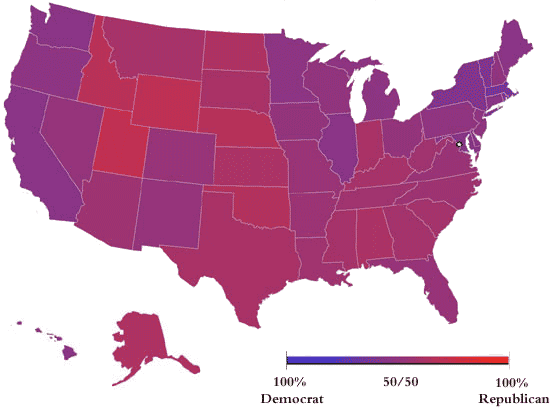
On a new kind of sentence fragment in TV newscasting: so-called "ing-lish." Plus: Overheard on Election Night; Tom Brokaw's pronunciation. temp link/perm.preview My closing line on "ing-lish" was cut: For the viewer already dizzy from all the news crawls, instant online polls and ever-shrinking sound bites, it's getting harder to tell the difference between what has happened, what is happening, and what will or may happen in the future. These days, everything seems to be happening at once. However, if you really dig grammar (God bless you!), you know that this line, and my line about "putting everything in the present," are regrettably misleading. Absolute phrases and gerunds have NO tense--they are non-finite, since they do not specify tense, agent, and number. There's a good, clear breakdown of this at I.G.O.E. My English professor's more thorough explanation is here. He adds a few common absolute phrases: "all things considered, all other things being equal, God willing..." This essay at News Lab and this PBS segment suggest the phenomenon has something to do with "dropping the verb," but in fact only the auxiliary verb ("is," "have been," etc.) is dropped; the verb remains in something resembling absolute form. More on newsspeak here and on Election Night here. Transcript of CNN's 7 p.m. hour of Election Night here. The Seattle Times on how the media can get it right next time. And more Ratherisms. I was really interested by David Gergen's "locust of lawyers." Here's more: locusts United Press International October 15, 2004 Friday HEADLINE: Analysis: Will lawyers decide the vote? BYLINE: By MICHAEL KIRKLAND Like a biblical plague of locusts, lawyers are gathering by the thousands at the call of the Democratic and Republican parties to handle voting-related court challenges both before and after the Nov. 2 presidential election. Election Integrity At Stake By George F. Will Sunday, October 24, 2004; Today's worry concerns a cloud of locust-like lawyers asserting novel theories that purport to demonstrate that sensible rules, such as requiring voters to have identification, are illegal, even unconstitutional. This locust litigation will erupt around any close election -- any not won beyond "the margin of litigation." link CNN: GERGEN: What the attorneys will be looking for is the same thing the monitors will be looking for. And both sides will have them out in force. As George Will called them, the locust of lawyers. Inflections: • Slogan of the Nader campaign, qtd in the Chi.Tribune: Bush and Kerry make me want to Ralph. • "'Wal-Mart Republicans' is probably more accurate [than "Religious Right"], given that Bush's majority was built up in the same kinds of small communities where the world's largest retailer thrives." x • "I have to admit that I am a little confused by all this talk of 'man date' by Republican leaders in the days since the election. I thought they were opposed to same-sex fooling around." x (more on mandate) • This was from a rerun of either Seinfeld or Sex in the City, I forget which: To boyfriend: "Here's the thing." Bf: "Oh no, not the thing! I hate the thing." • A word from WorldWideWords I want to save: sonofusion • My wife spotted a flyer nailed to a phone pole that said "Found: Lost Cat." "It's not really lost anymore, is it?" she observed. On the other hand, the alternative is posting a flyer that says: "Found: Cat That Had Been Lost At The Time We Found It But As Of Its Finding Is No Longer Lost" • Someone found this blog by doing a search for the architect of the "ifill tower." (I had posted a quote from the debate moderated by Gwen Ifill, and said something somewhere about a tower, so voila.) I wonder if that surname was originally someone's attempt to name their family after the famous landmark? I doubt it; the name is probably older than the tower. • "If "The Incredibles" did not exist, it would be necessary to invent them," wrote the Tribune. This is approaching cliche territory, suggests a quick search for "If x did not exist, it would be necessary to invent him/her/them." • Googling my name (everyone's entitled now and then), I found this post from a Lon Bierma, my relation to whom (if any) I don't know. From: Lon Bierma • Previous column and inflections • Etymology Today from M-W: nexus \NEK-sus\ 1 : connection, link; also : a causal link 2 : a connected group or series 3 : center, focus "Nexus" is all about connections. The word comes from "nectere," a Latin verb meaning "to bind." A number of other English words are related to "nectere." The most obvious is "connect," but "annex" (meaning "to attach as an addition," or more specifically "to incorporate into a political domain") is related as well. When "nexus" came into English in the 17th century, it meant "connection." Eventually, it took on the additional meaning "connected series" (as in "a nexus of relationships"). In the past few decades it has taken a third meaning: "center" (as in "the trade nexus of the region"), perhaps from the notion that a point in the center of an arrangement serves to join together the objects that surround it. • Previous E.T. Red and Blue America? Nope
George Bush is already proclaiming a mandate, for chrissakes. If the narrow margin of victory in this election had swung the other way, does anyone doubt for a moment that an army of Republican surrogates would have immediately fanned out to the shouting-head shows to argue, until they were collectively blue in the face, that the election of John Kerry was nothing more than a statistical fluke that certainly carried with it no greater meaning? "I'll reach out to everyone who shares our goals." - George W. Bush, 11/4/04 Now that's conciliatory! "How can 59,054,087 people be so DUMB?"
'Tis the season--yes, already--for Christmas decorations. I did this brief for Chicago Tribune Magazine last year: Q: ARE RETAILERS STILL PUTTING UP CHRISTMAS DISPLAYS EVER EARLIER? My column on Christmas Web sites Posted without comment... For a leap of faith, that's the breaks Is this true? The wretches who roam around aimlessly in gangs and kill people by throwing stones from a highway bridge or setting fire to a child--whoever these people are--turn out this way not because they have been corrupted by computer "new-speak" (they don't even have access to a computer) but rather because they are excluded from the universe of literature, and from those places where, through education and discussion, they might be reached by a glimmer from the world of values that stems from and sends us back again to books. -Umberto Eco, On Literature Last month was National Novel Writing Month. Yeah, like there aren't enough poorly written novels around. Napoleon was, in writing, at least, quite the Romeo, according to the new book The Linguist and The Emperor: I have awakened full of you. The memory of last night has given my senses no rest... Sweet and incomparable Josephine, what an effect you have on my heart! I sent you thousands of kisses---but don't kiss me. Your kisses sear my blood. p26 G.K. Chesterton on journalism: We announce on flaring posters that a man has fallen off a scaffolding. We do not announce on flaring posters that a man has not fallen off a scaffolding. Yet this latter fact is fundamentally more exciting, as indicating that that moving tower of terror and mystery, a man, is still abroad upon the earth. That the man has not fallen off a scaffolding is really more sensational; and it is also some thousand times more common. But journalism cannot reasonably be expected thus to insist upon the permanent miracles. Busy editors cannot be expected to put on their posters, “Mr. Wilkinson still safe” or “Mr. Jones, of Worthing, not dead yet.” link Nation's Poor Win Election For Nation's Rich x Kerry Captures Bin Laden One Week Too Late x Nation's Wildlife Fleeing To Canada Self-Help Book Believes It Can Be A Bestseller Someday x wdyt: "Our nation may be bitterly divided, but at least our government can agree on being ultra-conservative." "Now that the Republicans run Congress, the White House, and soon the Supreme Court, they'll just have to invent some new branches of government to dominate, as well." "The fact that 48 percent of Americans voted for a boring placeholder like John Kerry is actually a really good sign for the Left." |